
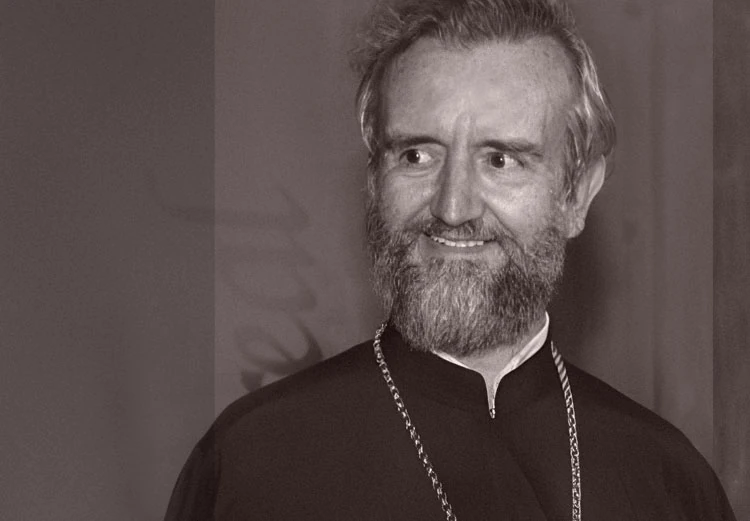
Broadening the Horizons of Metropolitan John Zizioulas’s Theology
International Conference on the Thought and Legacy of Metropolitan John (Zizioulas) of Pergamon
Monastery of the Dormition of the Most Holy Theotokos, Hildesheim, Germany
October 15–18, 2026
Participants and Program · Photo Gallery
A Legacy Opening to the Future: The Hildesheim Conference on Metropolitan John Zizioulas’s Theology
The Hildesheim conference brought Metropolitan John’s theological legacy into conversation with contemporary questions of freedom, human dignity, Christian unity, ecology, and artificial intelligence.
From 15 to 18 October 2026, the Monastery of the Dormition of the Most Holy Theotokos in Hildesheim, Germany, welcomed the international conference “Broadening the Horizons of Metropolitan John Zizioulas’s Theology.” Organized by the John Zizioulas Foundation and the Serbian Orthodox Diocese of Germany, and hosted by Metropolitan Grigorije, the gathering received the support of Fordham University’s Orthodox Christian Studies Center, the Faculty of Theology at the University of Göttingen, and the Volos Academy for Theological Studies. Scholars from different ecclesial traditions and generations came together to examine the continuing significance of Metropolitan John’s work and the possibilities for its further development.
The conference answered an invitation close to Metropolitan John’s own heart: that his students and successors should carry his thinking further, exploring questions and fields he had not had time to pursue. In his message to the gathering, Ecumenical Patriarch Bartholomew emphasized the creative and existential character of this theological inheritance, encouraging an engagement with the world nourished by the Church’s liturgical experience. Andreas Goulas, President of the Foundation, likewise affirmed the responsibility to preserve Metropolitan John’s work, make it accessible, and encourage its creative reception.
A recurring concern was how to receive a theology whose familiar expressions can sometimes obscure its deeper meaning. Marko Vilotić returned to the central place of the other and of love, questioning interpretations that turn episcopal ministry into authoritarianism or detach eschatology from responsibility for the concrete neighbor. Sarah Elizabeth Hunt reopened the dialogue between Zizioulas and Sergii Bulgakov, challenging a sharp opposition between their accounts of creation and asking how creation’s promised fulfilment is already related to its beginning. In dialogue with Catherine LaCugna, Alexander Hurtsellers asked how an ontology of communion can attend more fully to lived circumstances, particularly to persons at the margins of ecclesial life.
The Eucharist remained central to these explorations. Augustin Viorel Coman considered the prospects of eucharistic ecclesiology amid digital forms of participation, individualised spirituality, crises of authority, social fragmentation, and a culture absorbed in the immediate present. Thomas Ruston challenged the widespread classification of Zizioulas as a social trinitarian, arguing that his account of the Church and personhood rests on participation in Christ’s filial communion with the Father. This raised a question with implications throughout the conference: how should the relationship between divine life and human communion be understood?
That question received close attention in the contributions of Dario Chiapetti and George Tserodze. Chiapetti examined the monarchy of the Father as the foundation of freedom and otherness, tracing its implications for ecclesial existence and humanity’s priestly vocation. Tserodze distinguished the divine causation of personal being from the mutual recognition and affirmation of human persons. His contribution asked how communion can preserve the freedom of the other without making one human being the source or determining condition of another’s identity.
The reception of Metropolitan John’s theology across traditions and cultures formed another important dimension. From a Lutheran perspective, Jennifer Wasmuth considered how eucharistic ecclesiology can challenge nationalism and cultural fragmentation while also inviting questions about episcopacy and historical ecclesial structures. Georges El-Hage brought Zizioulas into dialogue with Metropolitan George Khodr and Father Jean Corbon, asking how the Church can belong to a particular place and people while remaining open to the world. These encounters demonstrated how reception in a new context can disclose fresh questions within a theological inheritance.
Human rights and political life provided a particularly fruitful field of constructive disagreement. Aristotle Papanikolaou developed a relational account of human rights inspired by Zizioulas’s theology of personhood, bringing it into conversation with Rowan Williams’s understanding of recognition and solidarity. Isidoros Katsos revisited the relationship between personhood, natural law, and natural rights, proposing that nature’s vocation to communion can ground claims against unjust legislation. Dionysios Skliris explored the democratic possibilities of Zizioulas’s ecclesiology while acknowledging the distance between eucharistic freedom and political structures marked by coercion. Together, these contributions opened further discussion about the passage from theological anthropology to public responsibility.
The programme also carried these theological questions into pressing contemporary debates. Pia Chaudhari considered artificial intelligence, consciousness, and the growing use of AI as an object of emotional attachment through Zizioulas’s understanding of personhood. Richard René critically developed the understanding of humanity as “priest of creation,” proposing a priestly vocation exercised within the community of living beings through self-emptying service. Both contributions showed how Metropolitan John’s categories can generate new inquiry into relationships whose significance continues to unfold.
Eschatology—the understanding of existence in the light of its fulfilment in God—connected discussions of creation, salvation, and human destiny. Pantelis Kalaitzidis examined deification through incorporation into Christ and participation in his relationship with the Father. Petr Soukal explored the implications for original sin, approaching the fall as a loss of humanity’s future fulfilment in communion.
The international reach of this theology also found a concrete expression in the Finnish translation presented during the gathering, undertaken by Esa Erävalo, a layman inspired by Metropolitan John’s work. Alongside the academic exchanges, the exhibition prepared by Marija Aćimović offered participants another way to encounter his life and legacy. The monastery’s hospitality gave these conversations a setting in which theological study, worship, and personal encounter could enrich one another.
The concluding plenary discussion, moderated by Bishop Maxim, brought the conference’s open questions into focus. Bishop Isidoros, Sarah Elizabeth Hunt, and Thomas Ruston offered responses from the podium, while contributions from the floor included those of Andrej Jeftić, Thomas Bremer, Metropolitan Maximos of Selyvria, Aristotle Papanikolaou, and Pantelis Kalaitzidis, among others. The conversation was framed by Metropolitan John’s hope that his students and successors would explore areas he himself had not had time to pursue. Participants were invited to identify unresolved tensions and priorities for further research, with particular attention to the connections between ontology, ecclesiology, and ethics, the continuing exploration of the Eucharist, and the possibilities opened by encounters with art, literature, music, and science.
The plenary gave concrete expression to the conference’s purpose: receiving Metropolitan John’s theology through a shared commitment to its further development. Its guiding questions encouraged participants to consider what requires clearer argument, which problems remain open, and what the next generation should investigate. These questions will help shape the Foundation’s future scholarly work and its continuing encouragement of dialogue across disciplines and ecclesial traditions.
As an expression of gratitude for his hospitality, the Foundation, through its President, Andreas Goulas, presented Metropolitan Grigorije with a Panagia enkolpion that had belonged to Metropolitan John—a personal remembrance of the hierarch whose theological legacy had brought the participants together. In thanking the Foundation for this gift, Metropolitan Grigorije recalled losing his father in early childhood and gazing at photographs of him on the walls of the family home, wondering whether his father was looking back at him. Surrounded by photographs of Metropolitan John in the conference hall, he returned to that childhood question: “Is Zizioulas watching this now?” His words brought a deeply personal dimension to the gathering’s reflections on personhood, communion, and the hope of life beyond death.
Looking ahead, plans include the publication of the conference proceedings and continued engagement through the Foundation’s journal, OmegAlpha. The hope was also expressed that a further conference might take place in 2028 at the Catholic University of America in Washington, D.C., with greater attention to theology and the arts, liturgical theology, and the experience of worship.
For the John Zizioulas Foundation, the Hildesheim gathering gives renewed direction to its work. The questions opened by Metropolitan John’s theology continue to call for careful scholarship, critical dialogue, and imaginative development. Carrying that work forward means allowing communion, freedom, and otherness to shape both the questions theology asks and the encounters through which it seeks understanding.
Video recordings
The video recordings of the conference can be watched in a playlist on YouTube.