
Distinguished John Zizioulas Lecture Series
Department of Theology, National and Kapodistrian University of Athens
The Department of Theology at the National and Kapodistrian University of Athens is pleased to announce this year's Distinguished John Zizioulas Lecture Series. This series explores key themes in historical and systematic theology, engaging with contemporary theological, philosophical, and intellectual challenges from the perspective of Orthodox theological wisdom and tradition.
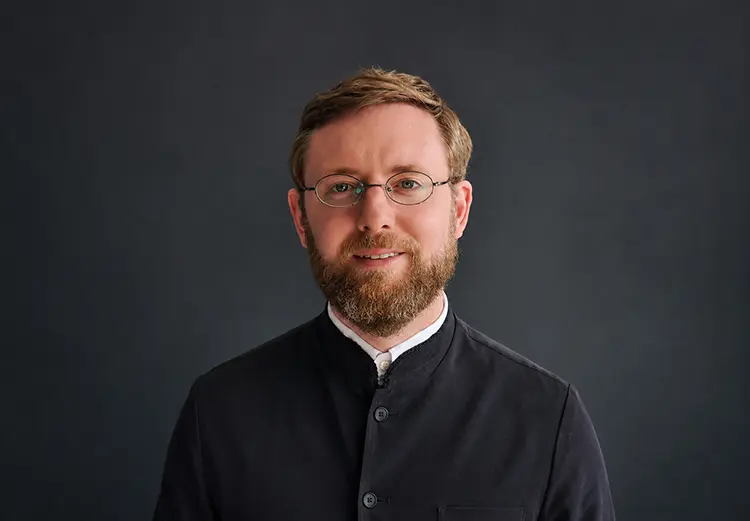
This year, we are honored to welcome Fr Alexis Torrance, Professor of Byzantine Theology, University of Notre Dame who will deliver a lecture titled:
The Gift of Reason and the Future of Orthodox Theology
Dear and Most Reverend representative of the Ecumenical Patriarchate, Fr Isidoros Katsos, Most Reverend representative of the Metropolitans of our Church, beloved faculty and students of the University, and esteemed friends,
I am deeply humbled and privileged to be here in this revered centre of Orthodox theological education and research in order to speak about a matter that has been at the very heart of my intellectual journey and formation. To do so here, in the presence of those who gathered to celebrate the legacy of Metropolitan John Zizioulas, one of the most seminal Orthodox theological minds of our time, is truly an honor beyond measure.
The late Metropolitan John's entire theological tour de force, Remembering the Future, which develops a salutary eschatological ontology to counter many of the problems and temptations in theology today, has been in large part an extended meditation upon the theme that brings us together this evening: the place and function of reason, or logos, within the life and thought of the Church. My own journey to theology is marked by interactions with His Eminence and his work. Fittingly, before I ever opened the pages of Being as Communion, I was first introduced to the theology of the blessed metropolitan when I was teenager by attending a Divine Liturgy at the cathedral in Paris, where he was celebrating. I had not yet seen the Metropolitan celebrating the Liturgy before reading his writings. These themes were not simply propositions for him; rather, they were lived, embodied, and indeed liturgically articulated.
I have explored and engaged with many features of Metropolitan John's thought in various talks and papers, several of which have been collected for publication. My current book project for Oxford University Press, which is entitled Recovering the craft of Orthodox Theology is, in part, an homage to what Metropolitan John represented, and what urgently needs to be recovered, to ensure a bright future for Orthodox theology. The renaissance that began through the neopatristic synthesis of the twentieth century, and which came to such fine expression in the life and work of Metropolitan John, must continue to inform the shape and character of Orthodox theological work and witness in the twenty-first century and beyond.
Allow me, then, to offer some preliminary remarks about the logos — about reason itself — within the context of Orthodox theological tradition. I will attempt to indicate the critical importance of reason and rational discourse for theology in the patristic period and beyond, and I will try to offer some contemporary applications that show that reason is neither to be feared nor rejected by Orthodox theology, but rather received, refined, and properly oriented within the deeper logic of the faith and the life of the Church.
The ancient Church recognized something profoundly important about the nature of human rationality. The Fathers and Mothers of the Church who shaped the doctrine of the Church in the patristic period were not afraid of reason or of rational argumentation. To the contrary: they understood that God had given humanity the gift of reason itself, and that this gift was to be used in the service of understanding and articulating the truth of the Gospel and the mysteries of faith. Far from being opposed to faith, reason was regarded as a necessary instrument in the Church's ongoing work of receiving and handing on the apostolic tradition.
Yet there is a critical caveat. He took this idea seriously, despite the criticisms of some that he was allegedly trying to conform the tradition to foreign philosophical categories. In Metropolitan John's theological vision, articulated most comprehensively in Remembering the Future, faith in the resurrection of Christ (whose apodosis we celebrate today), forms a lens through which reason itself is transfigured and reoriented. The resurrection does not circumvent reason; it fulfills it. Reason is legitimized not when it stands apart from revelation, but when it participates in the truth that the resurrection discloses: namely, that being itself is fundamentally relational and personal.
This is the great gift of reason in Orthodox theology: the recognition that our rational nature, far from being an obstacle to faith, is a faculty that has been created to apprehend and articulate the deepest truths of the Gospel. And the future of Orthodox theology depends, in no small measure, upon the recovery of this vision: a vision that honors the gift of reason while submitting it ever anew to the transformative power of the Gospel and the living tradition of the Church.